Which oil goes where, and how. Written for my vata prakriti, mostly with the sinus in mind.1 Pitta entries are from general references.
Basics
- Warm oil. Cold oil aggravates vata. Kapha takes it warm to hot, pitta lukewarm.
- Vata is dry, light, cold, rough, mobile. Heavy, warm, generous oil.
- Kapha is heavy, slow, cold, oily, dense. The least oil that works: light, hot, brisk.
- Pitta is hot, sharp, a little oily. Cooling oils, moderate amounts.
- Vata and kapha are both cold, so warming oils serve both. Vata takes it heavy and generous, kapha in the smallest amount that works.
Abhyanga (body massage)
- Vata
- Sesame oil as the base.
- Almond oil for face and head. Lighter than sesame.
- Mahanarayana taila mixed into the sesame. Joints, stiffness.
- Dhanwantharam taila. Rejuvenating, supports the nervous system, relieves fatigue.
- Bala taila or Bala Ashwagandhadi taila for thinness and fatigue.
- Ksheerabala taila for anxiety, insomnia, nerve pain.
- Sahacharadi taila for legs and sciatica. Karpasasthyadi taila for neck and shoulders.
- Castor oil is very heavy. One part in four of sesame.
- Ghee for dryness that comes with heat or irritation.
- Kapha
- Kottamchukkadi taila, Nirgundi taila, or plain mustard oil.
- Udvartana, dry powder massage with Kolakulathadi, instead of oil when heaviness is the issue.
- Prasarini taila for cold joints. Karpasasthyadi works here too.
- Coconut oil and ghee don’t suit kapha.
- Pitta
- Coconut oil as the base.
- Sunflower oil as a light base. Chandanadi taila for burning, heat, restless sleep.
- Ksheerabala and Dhanwantharam are tolerated. Sesame-based but gentle.
- Lukewarm oil. Mustard doesn’t suit pitta.
Hair and scalp
- Vata
- Sesame oil, almond oil.
- Bhringraj taila. Roots the hair, prevents premature hair fall, calms vata-type sleep issues.
- Bala Ashwagandhadi taila. Strengthens weak hair roots, relieves mental stress.
- Neelibhringadi taila or Brahmi Bhringadi taila for hair fall.
- Kapha
- Mustard oil.
- A light base with neem, rosemary or tulsi. Scalp only.
- Pitta
- Coconut oil base. Neelibhringadi for hair fall and early greying.
- Brahmi taila on the head for sleep and stress.
Nasya (nose)
- Anu taila. The traditional medicated oil for daily or therapeutic nasya. Clears the senses, grounds the nervous system.
- Helps with sinus and nasal blockage.2
- Almond oil on the face and head also helps the sinus.
- Warm the oil, head tilted back, two drops per nostril, sniff gently. Forceful inhaling can pull oil into the airway (lipoid pneumonia).
- Vata: Anu taila daily. Shadbindu taila for headaches. Ksheerabala 101 for anxiety.
- Kapha: Shadbindu, Vacha taila. Not ghee.
- Pitta: ghee, or Anu taila at the two-drop dose. Skip during fever or inflammation.
Ear oiling
- Warm sesame or Ksheerabala, weekly, for vata.
- Skip with any congestion or fluid in the ear.
How to apply
| Vata | Kapha | Pitta | |
|---|---|---|---|
| Amount | Generous, more than feels necessary | A thin film | Moderate |
| Pressure and speed | Slow, steady, long strokes | Brisk, vigorous | Even, unhurried |
| How often | Daily, or 3 to 4 times a week | 1 to 2 times a week, dry massage more often | 2 to 3 times a week |
| Leave it on | 20 to 30 minutes | 10 to 15 minutes | 15 to 20 minutes |
| Afterwards | Warm shower, little soap, keep a film | Hot shower, wash it off | Lukewarm shower |
| Time of day | Morning, or before bed | Morning | Morning or evening, not midday |
| Where to focus | Feet and scalp | Chest, back, joints. Light on a congested chest | Head, feet, palms |
| Oil temperature | Warm | Warm to hot | Lukewarm |
Oils by prakriti and use (interactive diagram)
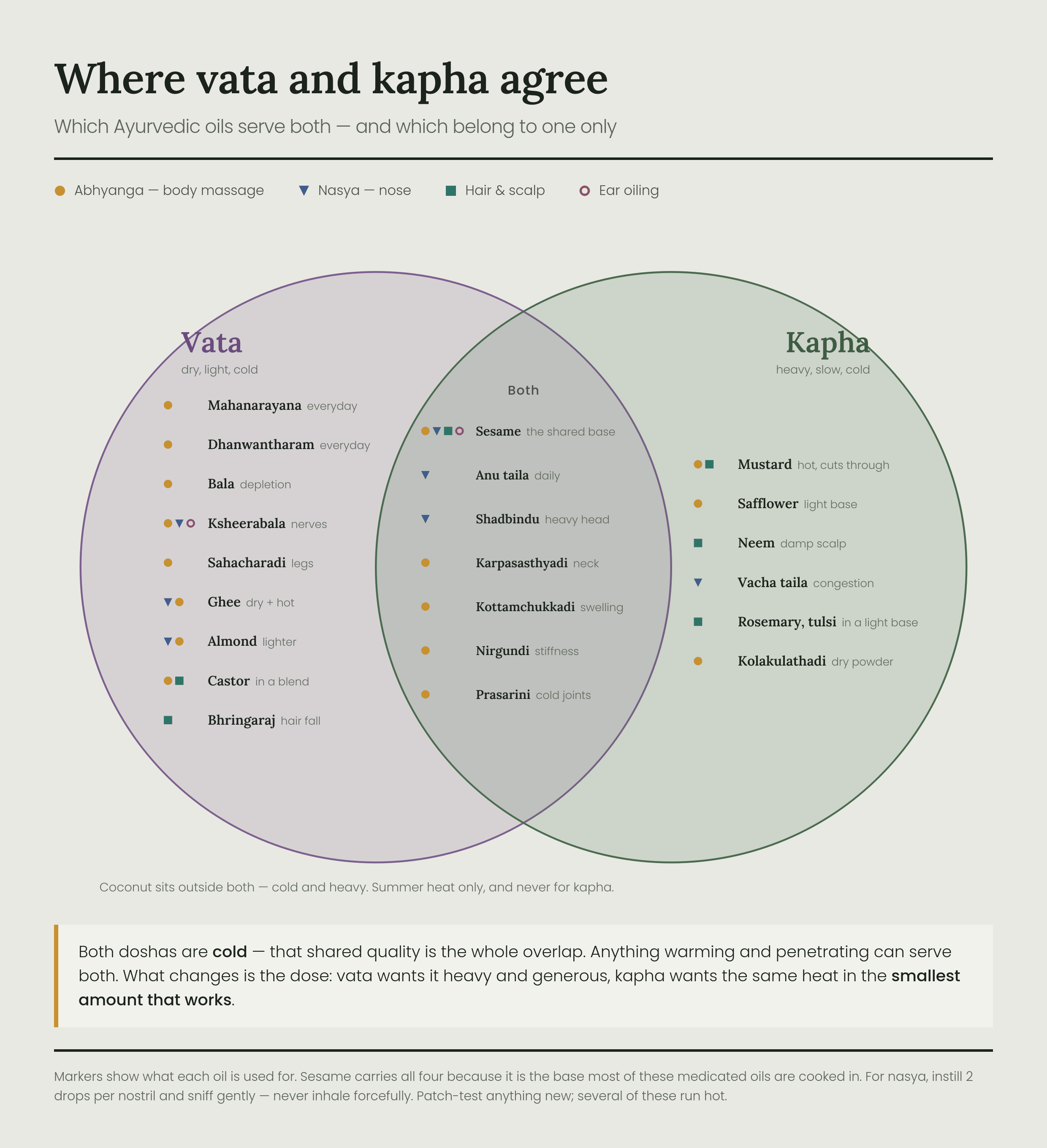
Vata and kapha
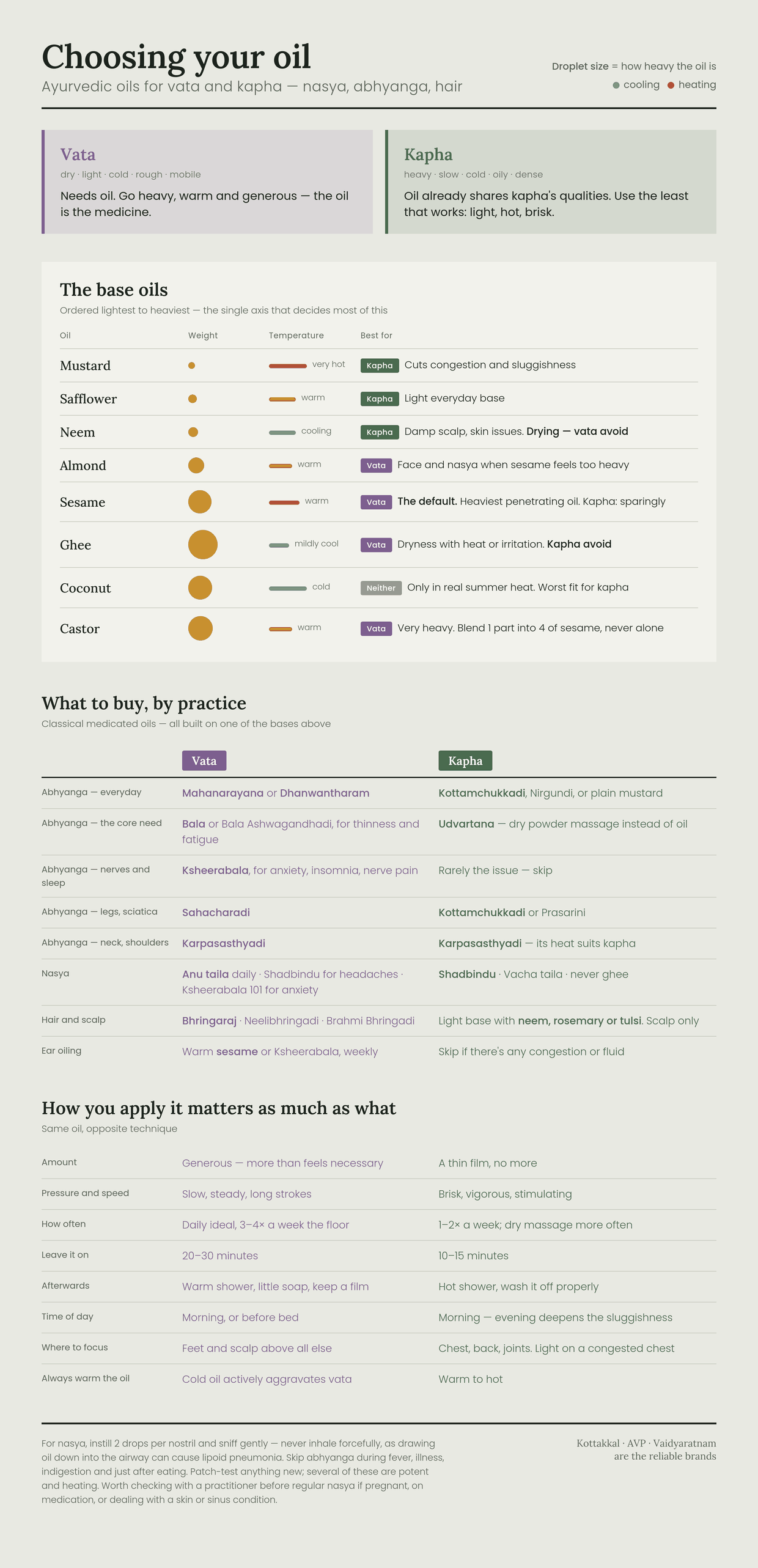
The two-dosha version the diagram above grew out of.
Base oils and medicated oils
Cautions
- Skip abhyanga during fever, illness, indigestion and right after eating.
- Patch-test anything new. Several of these are potent and heating.
- Check with a practitioner before regular nasya if pregnant, on medication, or with a skin or sinus condition.
- Kottakkal, AVP and Vaidyaratnam are the reliable brands.
Footnotes
-
From my consultation with a doctor at Kundalini Ayurveda, Lalitpur, Nepal, September 2026:
- Prakriti assessed as vata.
- Diagnosis: sinusitis, with a chronic headache going back 7 to 8 years, aggravated by environmental factors.
- External treatment: nasya for 7 days, then shirodhara and abhyanga for 3 days each, alternating.
- Internal: Septilin, one tablet at night after food. Chitrak Haritaki, morning and evening.
- Follow-up after 15 days.
- Septilin is a Himalaya tablet, guggulu and guduchi based, given for sinus and recurring infections. Chitrak Haritaki is an avaleha, a herbal jam, classically given for rhinitis and sinusitis.
-
Food to avoid for the sinus, per the doctor:
- curd, and only earlier in the day if at all
- sea food
- bamboo shoot (tama)
- black gram lentils (maash ko daal)
- banana
- green peas (kerau)
- raw and cold food in general